
Reflections on a Rocky Decade
Keynote Address by Sarah Beran at the Jimmy Carter Forum on U.S.-China Relations 2026

In December, I announced that China Focus (the Carter Center initiative responsible for the U.S.-China Perception Monitor) had a new website and would be operating its newsletter from there. It turns out I was only half right. First, I was half right in the sense that we have a new website, but the newsletter function doesn’t really compare to the ease or reach of Substack. We are unlikely to use it in the future. Second, I was half right in the sense that we will now be using Substack to share half or less of the best articles on our website. At the bottom of each newsletter, you will find a link to continue reading. As always, all our content is provided for free.
The following is a transcript of Sarah Beran keynote lecture from January 29, 2026 at the Jimmy Carter Forum on U.S.-China Relations. The theme of the Forum this year was Women in U.S.-China Relations.
Thanks,
Nick
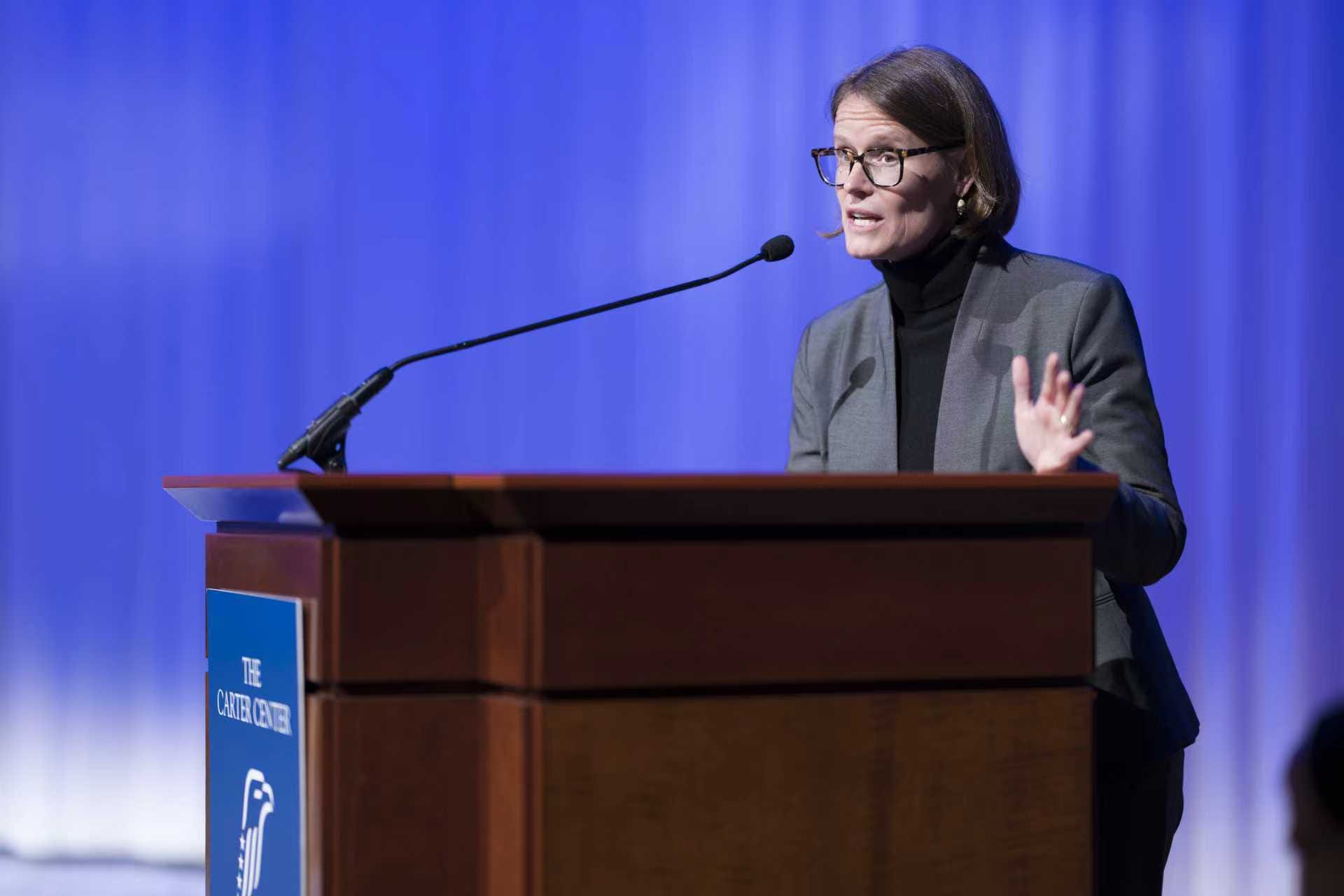
It is an honor to be here today at the Jimmy Carter Forum on US-China Relations to celebrate the role of women in the US-China relationship, recognize the role of President Carter in normalization, and reflect on the lessons we have learned over the last 47 years of US-China diplomacy, and in particular in this age of strategic competition. I first met the former President when I was working on the Middle East Peace Process, and later as part of election observer missions. His spirit of public service after he left office serves as an inspiration for those of us who left government service earlier than expected and seek to remain involved and effect positive change.
Before I begin, however, in keeping with the theme of this Forum, I want to recognize the women, many of whom are in the audience, that have played critical roles on US-China relations over the last several decades:
Jan Berris, the former diplomat at the Consulate General in Hong Kong who was instrumental in organizing ping pong diplomacy
Susan Shirk, the day-to-day manager of China policy at the State Department during the Jiang Zemin era and the run-up to WTO accession.
Charlene Barshefsky, the tough, exacting trade negotiator during the 1999 US-China bilateral agreement that paved the way for WTO succession.
Susan Thornton, the top US diplomat on Asia during the shift from a policy of engagement to one of strategic competition in the first Trump Administration.
And of course, outside track 1, the many, many women who helped both sides of this complicated relationship understand one another – Bonnie Glaser, Elizabeth Knup, Liz Economy, Meg Rithmire, Jessica Chen Weiss, Bonny Lin. I am certain that I am leaving out more names than I can count, but these scholars in particular played a critical role during my time in government in explaining and providing historical context that helped us craft policy.
Like Jan, my journey on China started with sports diplomacy – I was part of a high school soccer team that travelled to the Pearl River Delta, shortly after Deng Xiaoping made his southern tour to kick off the reform and opening era. At the time, there were still two currencies – one used by foreigners and one by Chinese, two tiers of prices, and no access with the outside world once we entered China – no email, no cell phones, and no internet. At some point, despite losing every single soccer match we played, I realized I was hooked. I studied Chinese in university, traveled to Beijing to study abroad, and returned after graduation to work in a joint-venture before joining the foreign service as a US diplomat specializing in China. Of course, the State Department in its infinite wisdom sent me to the Middle East for the next decade, but eventually I returned to China.
Observing China over this period of rapid change reinforced for me how unexpected the path ahead may be, and how nimble we must be both in our practical approach and also in our intellectual framework. The China we dealt with in the run-up to WTO accession is not the China we are dealing with today. There are different patterns of diplomacy and very different leaders on both sides. China’s hard power projection in the region has grown and the impact of the Chinese economic model on our own economy has sharpened.
As any student of international relations will tell you, structural dynamics are important in charting the course of a bilateral relationship, but I will not use our time today to repeat the well-known debates over rising and status quo powers. As a practitioner who has had a ringside seat to US-China diplomacy for the last 25 years, I will focus on the idiosyncratic elements that can have an equally critical impact on the relationship’s trajectory.
First, the personalities of leaders matter more than observers outside the system realize. And oftentimes more than strategy. This is particularly true in an era of more centralized authority on both sides. They inject an element of uncertainty and possibility. Leaders can hit it off and it can put the relationship on a new trajectory. I saw this dynamic firsthand with the strengthening of the US-India relationship, for example. The affinity between Indian Foreign Secretary Jaishankar and his US counterparts – they genuinely liked and trusted him – led both sides to take greater risks in their respective politics. While trust and affection is in short supply between the US and China, the relationship between the leaders does affect how Beijing deals with the White House and vice versa. President Biden and Xi Jinping spent significant time together as vice presidents, both in China and in the United States, and that familiarity bred some predictability, allowing space for progress on some issues.
Predictability, of course, is no longer a feature of leader-level meetings. That lack of predictability has limited the value of preparatory channels in building towards concrete progress. Instead, Beijing has learned that elevating all issues to President Trump will mean a more favorable hearing for its position. This is a significant deviation from its previous strategy of trying to shape the U.S. approach by building favorable constituencies bottom-up through dialogues.
Second, the maxim that all politics are local applies to foreign policy, and it is even more true in the era of the internet and social media. Presidents watch inflation, consumer sentiment, and yes, the bond market, shifting approaches unpredictably on foreign policy issues in response. President Biden held off on sanctioning Russia’s energy sector over concern about prices at the pump during an election year, leading Moscow to doubt his stomach for tough measures. This White House backed away from doubling tariffs on China – and indeed on European countries – over concerns about rising bond yields. And while the nature of the Chinese system means Chinese leaders are much less responsive to the concerns of their citizens, they still exhibit a high degree of sensitivity to staying on the right side of vocal netizens. These domestically-driven shifts are often misread by foreign counterparts as giving greater leverage than actually exists – very rarely does a counterpart understand the domestic politics of the other to a degree that they can calibrate strategic advantage. Instead, it can lead to miscalculation. Exhibit A: One of the primary drivers of today’s tactical truce between the US and China is Beijing’s need for a stable external environment to encourage recovery of consumer sentiment and the domestic economy. However, the Trump Administration gambled – and lost – in 2024 that the decision on whether to confront or fold in the face of US pressure would be an economic one. It was not. It was a political decision driven by Beijing’s need to show it would not back down in the face of US aggression….
Read the entire article for free HERE.
Sarah Beran is a former DCM in the American Embassy in Beijing, non-resident research fellow at the 21st China Center at the University of California, San Diego, and partner at Macro Advisory Group.
The views expressed in this article represent those of the author(s) and not those of The Carter Center.
Peace is always on the back foot. To promote peaceful cooperation between the United States and China, all content from the Monitor is provided here for free. If you would like to contribute to our work, please feel free to make a donation to The Carter Center. Please indicate your donation is for China Focus.
That’s all from Atlanta. Y’all be good.
Smart take on how leader personalities inject unpredictability into structural dynamics. The Biden-Xi relationship example really underscores this...their VP-level rapport created a channel that doesnt exist under Trump's transactional style. Also intresting how Beijing pivoted from bottom-up constituency building to direct leader appeals. That shift alone tells us alot about how they've adapted to different presidential styles and lost faith in track 2 diplomacy.